
15 Min to Discover Inspiring Innovation Stories Behind AI Corporate Success
Inroduction
Artificial Intelligence has moved from experimentation to practical business value. Across industries, companies are using intelligent systems to improve efficiency, understand customers, reduce costs, and create entirely new opportunities. AI Corporate Success is increasingly defined by how effectively businesses connect AI initiatives with measurable commercial objectives.
Table of Contents
- Inroduction
- The Power of AI in Business Innovation
- 1. Retail: Creating More Personalized Customer Experiences
- 2. Healthcare: Supporting Faster, Data-Driven Decisions
- 3. Manufacturing: Improving Efficiency and Reducing Waste
- 4. Customer Service: Automating High-Volume Interactions
- 5. Logistics: Predicting Demand and Improving Delivery
- Challenges SMEs Face When Adopting AI
- Real-Life Innovation Lessons for SMEs
- How SySpree Supports AI-Powered Innovation
- A Strategic Framework for AI Integration
- Building a Culture of AI Innovation
- Conclusion: Turning AI Innovation into Business Growth
For SMEs looking to move beyond established revenue levels, the lessons from larger organizations are especially valuable. Studying AI Corporate Success stories can reveal practical ways to adopt automation, analytics, personalization, and intelligent decision-making without attempting an expensive organization-wide transformation from day one.
The Power of AI in Business Innovation
AI is no longer limited to futuristic concepts or experimental research. It is already supporting customer service, forecasting, logistics, marketing, manufacturing, data analysis, and operational planning.
The strongest examples of AI Corporate Success share one important characteristic: technology is applied to a clearly defined business challenge rather than introduced simply because AI is popular.
1. Retail: Creating More Personalized Customer Experiences
Retail businesses generate large amounts of information through transactions, browsing activity, product interactions, and customer preferences. AI can analyze these patterns and help businesses provide more relevant experiences.
Recommendation systems, intelligent search tools, and Predictive Analytics can help retailers anticipate interests and improve product discovery. These capabilities demonstrate how AI Corporate Success can emerge from better use of existing customer data.
What SMEs Can Learn
- Recommend products based on browsing behaviour.
- Identify customers likely to make repeat purchases.
- Personalize promotions for different audience segments.
- Forecast demand for important products.
- Improve inventory planning using customer data.
For smaller businesses, AI Corporate Success does not require building complex systems internally. Many scalable AI platforms can be introduced gradually and expanded as business needs grow.
2. Healthcare: Supporting Faster, Data-Driven Decisions
Healthcare organizations work with large volumes of complex information. AI can help professionals identify patterns, organize data, and support decision-making when appropriately implemented and reviewed.
The broader lesson for corporate firms is that AI Corporate Success often comes from helping skilled professionals access useful information more efficiently rather than replacing their expertise.
Applications Beyond Healthcare
The same principle can apply to consulting, financial services, legal support, logistics, and other corporate environments. Intelligent systems can summarize information, flag anomalies, organize records, and highlight important trends.
Data Science and Analytics can strengthen AI Corporate Success by turning large datasets into information that decision-makers can interpret and use.

3. Manufacturing: Improving Efficiency and Reducing Waste
Manufacturing companies increasingly use AI to monitor equipment, forecast maintenance needs, optimize production schedules, and identify inefficiencies.
Predictive maintenance is a particularly useful example of AI Corporate Success. Instead of waiting for equipment to fail, businesses can analyze performance data and identify warning signals before major disruptions occur.
Lessons for Corporate Service Firms
Corporate service providers may not operate production lines, but similar thinking can be applied to workflows, staffing, customer service, and technology infrastructure.
- Identify delays before they affect clients.
- Forecast service demand.
- Automate routine quality checks.
- Detect unusual operational patterns.
- Allocate staff according to expected workloads.
These uses show that AI Corporate Success is often built through small improvements that compound across large volumes of work.
4. Customer Service: Automating High-Volume Interactions
Customer support teams often spend significant time answering repetitive questions. Chatbots and Virtual Assistants can handle basic enquiries, retrieve information, and direct customers to appropriate resources.
AI-Powered Automation allows firms to reduce repetitive workload while helping human employees focus on situations requiring judgment, empathy, or specialist knowledge.
This combination of automation and human expertise is an important model for AI Corporate Success.
Potential Customer Service Benefits
- Faster initial response times
- Round-the-clock basic assistance
- Consistent answers to common questions
- Better ticket classification
- More time for complex customer issues
5. Logistics: Predicting Demand and Improving Delivery
Logistics and supply-chain operations involve changing demand, transportation constraints, inventory levels, and customer expectations. AI can analyze these variables to support faster and more accurate planning.
For growing SMEs, AI Corporate Success can result from using predictive systems to reduce unnecessary delays, improve routing, and make resource allocation more efficient.
A Practical SME Scenario
Consider an e-commerce company facing inconsistent delivery performance. By combining historical order information, customer locations, and operational data, predictive tools can help identify likely demand patterns and improve dispatch planning.
The value of AI Corporate Success in this situation comes from solving a measurable operational problem rather than implementing AI simply for innovation.

Challenges SMEs Face When Adopting AI
1. Initial Investment
Budget concerns can discourage businesses from experimenting with AI. However, implementation does not have to begin with a large-scale transformation.
A focused pilot aimed at a single bottleneck can create evidence for future investment. This incremental approach makes AI Corporate Success more accessible to SMEs with limited technology budgets.
2. Skill Gaps
AI systems require technical knowledge, data understanding, and ongoing management. Smaller companies may not have every required capability internally.
Working with experienced technology partners can help close these gaps. Prompt Engineering, implementation support, analytics expertise, and employee training can all contribute to stronger AI Corporate Success.
3. Poor Data Quality
AI systems depend heavily on the information provided to them. Incomplete, inconsistent, or outdated data can weaken results.
Businesses should therefore review data quality, access permissions, ownership, and governance before depending on AI for important decisions.
4. Resistance to Change
Employees may worry that new technology will make their roles less important or introduce unfamiliar processes.
Successful AI Corporate Success initiatives explain how technology will support employees, reduce repetitive work, and improve their ability to perform higher-value tasks.
Real-Life Innovation Lessons for SMEs
Blue River Technology: Applying AI to Agriculture
Blue River Technology became known for applying computer vision and machine learning to agricultural processes. Its technology demonstrated how intelligent systems can identify individual plants and support more precise treatment decisions.
The broader AI Corporate Success lesson is that powerful innovation can emerge from solving highly specific industry problems.
What SMEs Should Take Away
- Start with a clearly defined operational challenge.
- Use available data intelligently.
- Measure the outcome of the AI implementation.
- Improve the solution before expanding it.
- Scale only after demonstrating practical value.

How SySpree Supports AI-Powered Innovation
SySpree helps businesses identify where AI can create meaningful operational and marketing improvements. Rather than beginning with technology, we begin with the business problem.
Our approach to AI Corporate Success evaluates existing workflows, customer experiences, available data, technical infrastructure, and measurable objectives.
AI-Powered Automation
AI-Powered Automation can streamline repetitive processes including information routing, reporting, customer communication, and administrative workflows.
Predictive Analytics
Predictive Analytics can help businesses anticipate customer behaviour, operational demand, sales opportunities, and potential risks.
Prompt Engineering
Prompt Engineering helps organizations improve the accuracy, consistency, and usefulness of interactions with generative AI systems.
Data Science and Analytics
Data Science and Analytics helps transform raw business information into useful insights that support better decision-making.
Combining these capabilities creates a practical foundation for AI Corporate Success without forcing businesses into unnecessary complexity.
A Strategic Framework for AI Integration
Step 1: Define the Business Objective
Start by identifying what needs to improve. This could include response times, operating costs, sales forecasting, customer retention, or employee productivity.
Clear objectives prevent AI Corporate Success programs from becoming technology experiments without measurable outcomes.
Step 2: Identify a Suitable AI Use Case
Choose a process where AI can deliver measurable value without creating unacceptable operational risk.
Step 3: Assess Your Data
Determine whether the necessary data is accurate, accessible, relevant, and properly governed.
Step 4: Launch a Focused Pilot
Begin with a controlled implementation. Track performance against an agreed baseline and gather feedback from employees and customers.
Step 5: Integrate Existing Systems
Third-Party Integrations can connect AI solutions with CRM platforms, analytics tools, operational systems, and customer portals.
Connected technology makes AI Corporate Success more sustainable by allowing information to move efficiently across the organization.
Step 6: Train Employees
Employees should understand how AI works within their roles, how to review outputs, and when human intervention is required.
Step 7: Measure and Improve
Review cost savings, productivity, accuracy, customer satisfaction, adoption rates, and revenue impact before expanding the solution.
Continuous improvement is central to AI Corporate Success because AI systems and business requirements both evolve over time.
Building a Culture of AI Innovation
Technology alone does not create transformation. Employees need an environment where experimentation, responsible learning, and process improvement are encouraged.
Businesses pursuing AI Corporate Success should communicate clearly about objectives, involve employees in implementation, and provide opportunities to learn new capabilities.
Ways to Encourage Innovation
- Create small cross-functional AI projects.
- Encourage employees to identify repetitive processes.
- Share successful experiments internally.
- Provide practical AI training.
- Reward improvements that create measurable business value.
Conclusion: Turning AI Innovation into Business Growth
AI is no longer limited to the world’s largest technology companies. Retailers, healthcare organizations, manufacturers, service providers, and ambitious SMEs are finding practical ways to use intelligent systems to improve operations and customer experiences.
The strongest AI Corporate Success stories begin with clear problems, realistic objectives, reliable data, and careful implementation.
For SMEs, the goal should not be adopting the most advanced AI technology available. The goal should be identifying solutions that improve efficiency, support employees, strengthen customer experiences, and contribute to sustainable growth.
With focused experimentation and the right expertise, AI Corporate Success can move from an ambitious idea to a measurable business advantage.
Ready to explore practical AI opportunities for your business? Contact SySpree to develop an AI strategy aligned with your operations, customers, and growth objectives.
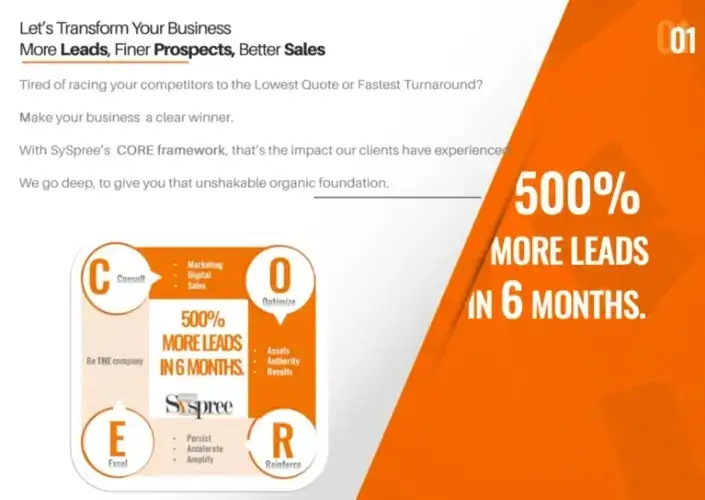
🚀 Want Results Like 500% More Leads in 4 Months?
Let’s talk about what these strategies can do for your business.
We’ll tailor a plan for your goals — no fluff, no pressure.
📧 Or just drop us a line at https://syspree.com/contact/
You may also like ( Author’s curated blogs for you) :
- How to Apply AI to Transform Corporate Service Delivery: A Game-Changer for Business Growth
- Unlocking Business Growth: 9 Digital Marketing Tactics for Corporate Services
- Harnessing the Future: Mastering Digital Marketing in the Corporate Services Sector
- PPC vs. Email Marketing: Which Delivers More for Corporate Firms?
- Observations on Social Media’s Role in Corporate Services

Nice post. I learn something totally new and challenging on websites
Uninstall Tool Reliable Fast and Thorough https://ursoftware.pages.dev
This was beautiful Admin. Thank you for your reflections.
Great information shared.. really enjoyed reading this post thank you author for sharing this post .. appreciated
I really like reading through a post that can make men and women think. Also, thank you for allowing me to comment!
This was beautiful Admin. Thank you for your reflections.
Great post,Thanks for sharing