
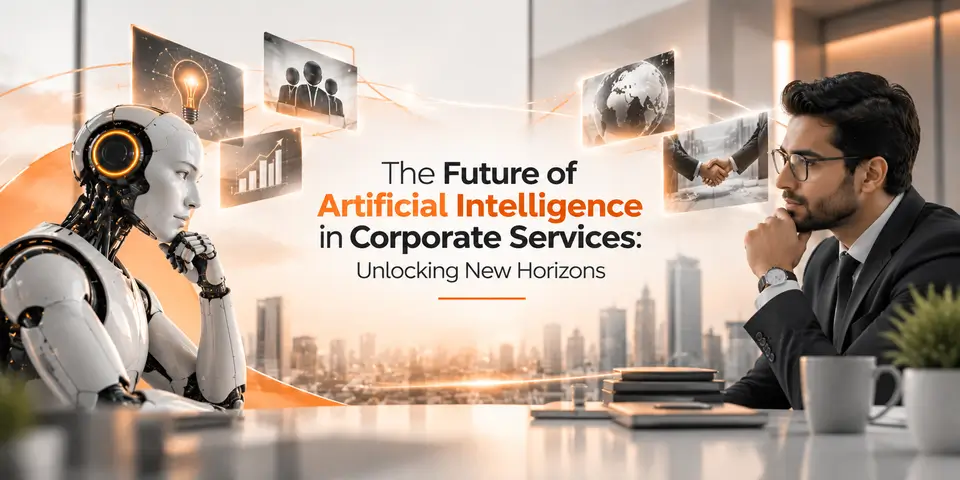
15 Min to Explore Transformative Innovations Shaping AI Corporate Future
Introduction
Artificial Intelligence is rapidly reshaping how companies operate, compete, and serve their customers. In 2026, corporate leaders are under increasing pressure to reduce costs, improve productivity, and make faster decisions. Understanding the AI Corporate Future is therefore becoming essential for businesses that want to build efficient and scalable operations.
Table of Contents
- Introduction
- Understanding the AI Revolution in Corporate Services
- The Current Direction of Corporate AI Adoption
- 1. AI in Marketing and Customer Relationship Management
- 2. Transforming Human Resources With AI
- 3. Revolutionizing Finance Departments
- 4. AI in IT and Cybersecurity
- 5. AI-Powered Automation Across Operations
- 6. Predictive Analytics and Smarter Decision-Making
- 7. Creating More Personalized Customer Experiences
- 8. Connecting AI Across Corporate Systems
- 9. AI and Human Expertise Will Work Together
- The Business Risks of Ignoring AI
- Common Myths About Corporate AI
- How to Incorporate AI Into Your Corporate Strategy
- How SySpree Supports AI-Powered Corporate Transformation
- What the Next Generation of Corporate Services Could Look Like
- Conclusion: Preparing for an AI-Driven Business Environment
For SMEs generating significant monthly revenue, AI presents opportunities that extend far beyond simple automation. A well-planned AI Corporate Future strategy can help organizations analyze information, anticipate customer needs, streamline workflows, and give employees more time for strategic responsibilities.
Understanding the AI Revolution in Corporate Services
What Is Artificial Intelligence?
Artificial Intelligence refers to technologies capable of performing tasks that normally require elements of human intelligence. These systems can analyze information, identify patterns, generate responses, make recommendations, and automate predefined activities.
Within the AI Corporate Future, these capabilities are becoming increasingly integrated into finance, marketing, human resources, customer service, IT, and operational management.
Why AI Matters to Corporate Firms
Businesses produce enormous amounts of information through customer interactions, transactions, websites, internal systems, marketing platforms, and employee activities. Turning this information into useful insights manually can be difficult and time-consuming.
The AI Corporate Future enables organizations to process this information more efficiently while helping decision-makers identify opportunities and operational problems earlier.
The Current Direction of Corporate AI Adoption
Companies are increasingly moving beyond isolated AI experiments toward practical applications connected to measurable business objectives. Instead of introducing technology simply because it is innovative, organizations are identifying processes where AI can improve speed, accuracy, scalability, or customer experience.
This shift is important because the AI Corporate Future will depend less on how many AI tools a company owns and more on how effectively those tools are integrated into everyday operations.

1. AI in Marketing and Customer Relationship Management
Marketing teams can use AI to analyze customer behaviour, segment audiences, personalize communication, identify sales opportunities, and understand campaign performance.
Predictive Analytics can examine historical information to estimate future customer behaviour. Within the AI Corporate Future, this can help businesses move from broad marketing campaigns toward more relevant and data-informed engagement.
Potential AI Marketing Applications
- Customer segmentation
- Lead scoring
- Campaign performance analysis
- Product recommendations
- Customer churn prediction
- Personalized marketing communication
Smarter Customer Interactions
Chatbots and Virtual Assistants can respond to common questions, collect customer information, qualify enquiries, and route complex requests to human employees.
The strongest AI Corporate Future customer strategies will combine automated convenience with human expertise whenever empathy, negotiation, or complex problem-solving is required.
2. Transforming Human Resources With AI
Human resources departments manage recruitment, onboarding, employee records, internal enquiries, performance information, and administrative workflows.
AI-Powered Automation can help streamline repetitive HR processes such as interview scheduling, document organization, onboarding reminders, and frequently asked employee questions.
For the AI Corporate Future, the objective should not be removing human professionals from HR. Instead, AI can reduce administrative pressure so HR teams can focus more heavily on employee development, workplace culture, and strategic workforce planning.
Potential HR Applications
- Application organization
- Interview scheduling
- Employee onboarding
- Internal knowledge assistance
- Workforce analytics
- Administrative workflow automation
3. Revolutionizing Finance Departments
Finance teams regularly process invoices, expenses, transaction records, forecasts, compliance information, and management reports. Many of these activities involve significant amounts of structured data.
The AI Corporate Future can help finance departments automate routine processing while giving professionals faster access to information needed for planning and analysis.
AI Applications in Finance
- Invoice classification
- Expense processing
- Financial forecasting
- Anomaly detection
- Automated reporting
- Cash-flow analysis
Human oversight remains essential, particularly for decisions involving regulatory obligations, significant financial commitments, or unusual transactions.
4. AI in IT and Cybersecurity
As corporate operations become more digital, businesses also face increasingly complex technology and security requirements.
Cybersecurity Solutions can use intelligent monitoring and automated analysis to help identify unusual activity, suspicious patterns, and potential threats.
Within the AI Corporate Future, AI can support security professionals by processing large amounts of system information quickly while allowing experienced teams to investigate and respond to important threats.
Potential AI Security Applications
- Threat detection
- Network monitoring
- Anomaly identification
- Security alert prioritization
- Fraud detection
- Automated incident analysis

5. AI-Powered Automation Across Operations
One of AI’s most significant corporate applications is automating repetitive processes that consume employee time.
AI-Powered Automation can support document processing, data classification, customer request routing, reporting, internal notifications, and workflow approvals.
The AI Corporate Future will increasingly involve intelligent workflows where routine activities are automated while employees remain responsible for exceptions, strategic decisions, and quality control.
6. Predictive Analytics and Smarter Decision-Making
Traditional business reporting explains what has already happened. Predictive Analytics can help organizations estimate what may happen next based on historical information and identifiable patterns.
Predictive Applications for Corporate Firms
- Revenue forecasting
- Customer churn prediction
- Demand forecasting
- Resource allocation
- Sales opportunity scoring
- Operational risk identification
For decision-makers, the AI Corporate Future could therefore mean moving from reactive management toward more proactive business planning.
7. Creating More Personalized Customer Experiences
Customers increasingly expect businesses to understand their preferences and provide relevant experiences. AI can analyze interactions across websites, customer service channels, purchases, and marketing campaigns.
Behavioral Targeting can use these signals to help organizations deliver more relevant recommendations and communication.
Personalization will be an important part of the AI Corporate Future, but companies should balance relevance with appropriate privacy, transparency, and data governance practices.
8. Connecting AI Across Corporate Systems
AI creates greater value when it can work with existing business systems rather than operating as an isolated application.
Third-Party Integrations can connect intelligent tools with CRM platforms, finance software, help desks, analytics systems, marketing platforms, and internal databases.
Connected technology will play an important role in the AI Corporate Future because information needs to move efficiently between systems for automation and analytics to deliver consistent results.
9. AI and Human Expertise Will Work Together
AI can process information quickly and automate repetitive activities, but businesses still require human creativity, judgment, empathy, leadership, and accountability.
The AI Corporate Future is therefore more likely to involve collaboration between people and intelligent systems than the complete replacement of employees.
AI Is Well Suited For
- Large-scale data processing
- Repetitive workflow execution
- Pattern identification
- Basic customer assistance
- Forecasting support
Humans Remain Essential For
- Strategic leadership
- Complex negotiations
- Creative thinking
- Sensitive customer interactions
- Ethical judgment
- Final accountability

The Business Risks of Ignoring AI
Organizations do not need to adopt every emerging AI tool. However, completely ignoring intelligent technology can create operational disadvantages as competitors become faster and more efficient.
Companies that fail to prepare for the AI Corporate Future may experience higher operating costs, slower decision-making, weaker customer experiences, and increasing dependence on manual processes.
Potential Consequences of Delayed Adoption
- Higher administrative costs
- Slower customer response times
- Limited use of business data
- Reduced scalability
- Lower employee productivity
- Difficulty competing with technology-enabled firms
Common Myths About Corporate AI
Myth 1: AI Will Replace Every Job
AI is particularly effective at automating specific tasks. Many corporate roles combine routine activities with responsibilities requiring experience, communication, creativity, and judgment.
Preparing for the AI Corporate Future therefore involves redesigning workflows so employees can use intelligent systems productively rather than assuming entire professions will automatically disappear.
Myth 2: AI Is Only for Large Enterprises
Cloud-based platforms and scalable AI services have made many capabilities accessible to SMEs. Businesses can begin with focused applications rather than building expensive AI infrastructure from scratch.
Myth 3: AI Can Operate Without Human Oversight
AI systems can generate inaccurate or inappropriate outputs. Important decisions require appropriate controls, monitoring, and human review.
How to Incorporate AI Into Your Corporate Strategy
Step 1: Assess Business Needs
Identify expensive, repetitive, slow, or data-intensive processes. Focus on areas where measurable improvements would create meaningful business value.
Step 2: Define Clear Objectives
Decide what AI should accomplish. Objectives might include reducing response times, lowering processing costs, improving forecasting, or increasing employee productivity.
Step 3: Evaluate Data Readiness
Determine whether the information required by the system is accurate, accessible, secure, and appropriately governed.
Step 4: Select the Right Technology
Choose tools based on the business problem rather than adopting technology simply because it is popular.
Step 5: Launch a Controlled Pilot
A focused pilot enables businesses to evaluate results and identify problems before committing to wider implementation.
This gradual approach can make preparation for the AI Corporate Future more manageable for SMEs with limited technology resources.
Step 6: Train Employees
Employees should understand how AI systems work within their responsibilities, how outputs should be reviewed, and when human intervention is necessary.
Step 7: Measure Performance
Performance Monitoring can help businesses determine whether an AI implementation is delivering the intended results.
Important AI KPIs
- Productivity improvement
- Processing time reduction
- Cost savings
- Error reduction
- Customer satisfaction
- Employee adoption
- Revenue impact
Continuous measurement will be fundamental to the AI Corporate Future because organizations need evidence that AI investments are creating genuine business value.
How SySpree Supports AI-Powered Corporate Transformation
SySpree helps businesses identify practical opportunities for AI, automation, analytics, and intelligent digital experiences.
Our approach to the AI Corporate Future begins with understanding the organization’s goals, operational challenges, existing technology, customer needs, and available data.
SySpree’s AI Capabilities
- AI-Powered Automation
- Predictive Analytics
- Prompt Engineering
- Data Science and Analytics
- Chatbots and Virtual Assistants
- Third-Party Integrations
Rather than implementing AI simply for innovation, businesses should focus on solutions that improve measurable outcomes. This practical philosophy can help companies prepare for the AI Corporate Future while controlling implementation complexity and risk.
What the Next Generation of Corporate Services Could Look Like
Corporate services are likely to become increasingly connected, automated, predictive, and personalized. Routine processes can be handled by intelligent workflows while employees concentrate on decisions requiring creativity, experience, and human understanding.
The AI Corporate Future will therefore be shaped not only by advances in technology but by how successfully organizations combine AI capabilities with skilled employees, responsible governance, and clear business objectives.
Conclusion: Preparing for an AI-Driven Business Environment
Artificial Intelligence is already influencing marketing, finance, HR, cybersecurity, customer service, analytics, and operational management. Its role within corporate services is likely to continue expanding as tools become more capable and accessible.
Businesses preparing for the AI Corporate Future should begin with practical problems, introduce focused solutions, measure outcomes, train employees, and expand successful applications gradually.
For growing SMEs, the objective is not to automate everything. It is to determine where intelligent technology can improve productivity, customer experience, decision-making, and scalability while maintaining appropriate human oversight.
Organizations that approach the AI Corporate Future strategically can build more adaptive operations and create a stronger foundation for sustainable growth.
Ready to prepare your corporate services for an AI-driven future? Contact SySpree to explore AI solutions aligned with your business operations and long-term growth objectives.
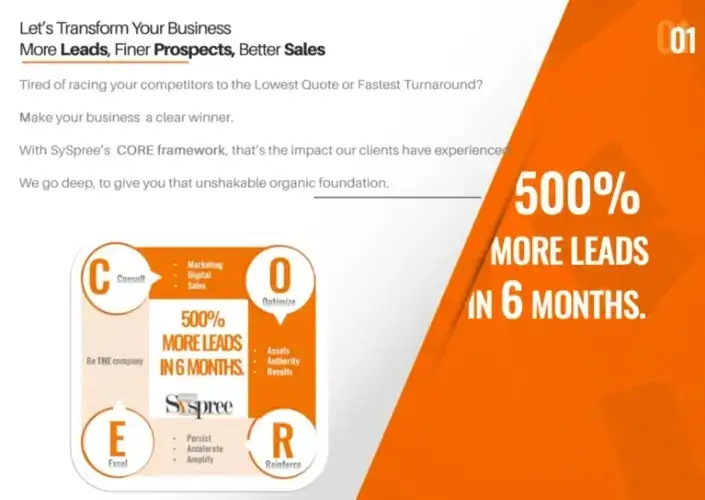
🚀 Want Results Like 500% More Leads in 4 Months?
Let’s talk about what these strategies can do for your business.
We’ll tailor a plan for your goals — no fluff, no pressure.
📧 Or just drop us a line at https://syspree.com/contact/
You may also like ( Author’s curated blogs for you) :
- AI Tools vs. Human Expertise: Which Works Better in Corporate Firms?
- Fresh Observations on AI Adoption in Corporate Services: Navigating the Future of Business Success
- Why Ignoring AI Slows Down Corporate Firms: The Untapped Potential of AI for Business Growth
- Analyzing AI’s Role in Automating Corporate Services: The Future is Here
- Transforming Success: Inspiring AI Innovation Stories from Top Corporate Firms
Good read! Our team works with hydraulic jacks 12 ton capacity for tanks for small- to mid-size tanks.
Very valuable article. Tank Lifting Equipment plays a key role in heavy industry.