
15 Min to Maximize Business Growth with Corporate Marketing ROI
Introduction
In the rapidly evolving corporate services landscape, digital marketing has become a major driver of growth, visibility, and scalability. However, launching campaigns does not automatically create profitable outcomes. Businesses need a clear framework for measuring Corporate Marketing ROI and understanding whether each channel is contributing to genuine business growth.
Table of Contents
- Introduction
- Why Measuring Digital Marketing ROI Matters
- The Basic Formula for Marketing ROI
- 1. Start with Clear Business Objectives
- 2. Build a Reliable Data and Analytics Toolkit
- 3. Measure More Than Clicks and Impressions
- 4. Improve Conversion Rate Optimization
- 5. Track Cost per Lead and Cost per Acquisition
- 6. Calculate Customer Lifetime Value
- 7. Use Attribution Models Carefully
- 8. Compare Channel Performance
- 9. Use Real-Time and Ongoing Performance Monitoring
- 10. Build Custom Reports for Decision-Makers
- A Practical ROI Example
- How SySpree Approaches Digital Marketing ROI
- Common Challenges in ROI Analysis
- Actionable Steps for Immediate Implementation
- Conclusion
For corporate firms generating more than USD 20,000 per month, every marketing investment should be evaluated against measurable results. A strong approach to Corporate Marketing ROI helps decision-makers identify what is working, reduce wasted spend, and allocate resources toward the campaigns most likely to generate qualified opportunities.

Why Measuring Digital Marketing ROI Matters
Corporate buyers often interact with several marketing touchpoints before making an enquiry. They may discover a company through search, read a case study, attend a webinar, open an email, and return through a paid advertisement. This makes Corporate Marketing ROI more complex than simply comparing advertising spend with immediate sales.
Without accurate measurement, businesses may continue investing in channels that appear active but contribute little to revenue. They may also undervalue campaigns that support long sales cycles and influence conversions indirectly.
The Basic Formula for Marketing ROI
The standard formula is:
ROI = ((Revenue Generated – Marketing Cost) / Marketing Cost) × 100
This formula provides a useful starting point for calculating Corporate Marketing ROI. However, corporate service firms must also consider sales cycles, lead quality, customer lifetime value, attribution, and the combined influence of multiple digital channels.
1. Start with Clear Business Objectives
Reliable measurement begins with a precise definition of success. A campaign designed to generate leads requires different metrics from one focused on retention, awareness, or account expansion.
Your Corporate Marketing ROI framework should connect each campaign to a measurable business objective.
- Increase qualified leads by 20% within six months.
- Reduce cost per acquisition across paid campaigns.
- Improve conversion rates on high-value service pages.
- Increase repeat business from existing clients.
- Generate a defined pipeline value from digital channels.
Clear objectives make Corporate Marketing ROI easier to evaluate and help teams avoid reporting on metrics that look impressive but have limited commercial value.
2. Build a Reliable Data and Analytics Toolkit
Accurate ROI analysis depends on clean, connected data. Analytics platforms, customer relationship management systems, advertising dashboards, and email tools should provide a consistent view of marketing activity.
Third-Party Integrations can connect these platforms and create a more complete picture of the customer journey. This gives businesses stronger data for calculating Corporate Marketing ROI.
Useful Data Sources
- Website analytics platforms
- CRM and sales pipeline systems
- Advertising dashboards
- Email marketing reports
- Call tracking platforms
- Social media analytics
- Custom Reporting dashboards
The goal is not to collect every available data point. The goal is to capture the information needed to explain how marketing activity contributes to revenue.

3. Measure More Than Clicks and Impressions
Clicks, views, likes, and shares can indicate initial interest, but they do not prove profitability. Strong Corporate Marketing ROI analysis focuses on how audiences move from attention to action.
Engagement Metrics That Matter
- Time spent on key service pages
- Landing-page conversion rates
- Form completion rates
- Content downloads
- Webinar registrations
- Repeat website visits
- Progression through the sales funnel
These metrics provide context and help teams understand which experiences are contributing to Corporate Marketing ROI.
4. Improve Conversion Rate Optimization
Generating more traffic is not always the most efficient way to improve returns. In many cases, companies can create better results by converting a higher percentage of their existing visitors.
UI/UX Audits can identify confusing navigation, weak calls to action, slow forms, poor mobile usability, and content gaps. Addressing these issues can improve Corporate Marketing ROI without requiring a major increase in advertising spend.
Conversion Improvements to Test
- Shorter enquiry forms
- Clearer service-page headlines
- Stronger calls to action
- More visible testimonials and case studies
- Dedicated landing pages for specific campaigns
- Alternative offers and lead magnets
A/B testing these elements helps businesses identify which changes have the greatest impact on Corporate Marketing ROI.
5. Track Cost per Lead and Cost per Acquisition
Cost per lead measures how much a company spends to generate an enquiry. Cost per acquisition measures how much it spends to secure a new customer.
These metrics are essential for comparing channels and improving Corporate Marketing ROI. However, lead volume should never be reviewed without lead quality.
A channel that generates fewer leads may still be more profitable if those leads convert at a higher rate or produce larger contracts.

6. Calculate Customer Lifetime Value
Customer Lifetime Value estimates the total revenue or profit a client may generate throughout the relationship. This is especially important for corporate service firms with recurring contracts, retainers, or cross-selling opportunities.
Including lifetime value provides a more accurate view of Corporate Marketing ROI than measuring only the revenue from an initial transaction.
Factors That Influence Lifetime Value
- Average contract value
- Length of the client relationship
- Renewal rates
- Cross-selling and upselling potential
- Service delivery costs
- Customer retention expenses
7. Use Attribution Models Carefully
Attribution determines how conversion credit is assigned across marketing touchpoints. First-click attribution credits the original source, while last-click attribution credits the final interaction. Multi-touch models distribute credit across several stages.
The right model depends on the sales cycle and available data. For complex B2B journeys, a multi-touch approach often gives a more realistic picture of Corporate Marketing ROI.
Common Attribution Models
- First-click attribution
- Last-click attribution
- Linear attribution
- Time-decay attribution
- Position-based attribution
- Data-driven attribution
No attribution model is perfect. The purpose is to improve decision-making, not to create a false sense of absolute certainty.
8. Compare Channel Performance
Search Engine Optimization (SEO), Pay-Per-Click Advertising (PPC), Social Media Marketing, Content Marketing, and Email Marketing contribute to different parts of the customer journey.
Comparing these channels helps teams understand which combinations produce the strongest Corporate Marketing ROI.
Questions to Ask
- Which channels generate the most qualified leads?
- Which channels influence the largest opportunities?
- Which campaigns have the lowest acquisition cost?
- Which content assists conversions later in the journey?
- Which channels support retention and repeat business?

9. Use Real-Time and Ongoing Performance Monitoring
Campaign performance can change quickly because of market conditions, seasonal demand, audience behaviour, and competitor activity. Performance Monitoring helps marketing teams identify issues and opportunities before significant budget is wasted.
Real-time insights make it easier to protect Corporate Marketing ROI by adjusting bids, targeting, creative assets, landing pages, and campaign timing.
10. Build Custom Reports for Decision-Makers
Senior leaders do not need every available marketing metric. They need clear information about cost, revenue, pipeline contribution, lead quality, and strategic progress.
Custom Reporting helps translate campaign data into a format that supports better decisions. A useful dashboard should show Corporate Marketing ROI alongside the assumptions, time period, and data sources used in the calculation.
Metrics to Include in an Executive Dashboard
- Total marketing investment
- Revenue attributed to marketing
- Qualified leads by source
- Cost per lead
- Cost per acquisition
- Pipeline value influenced
- Customer lifetime value
- Overall return by channel
A Practical ROI Example
Consider a corporate consultancy that invests USD 25,000 in a six-month digital campaign. The campaign generates USD 75,000 in attributable revenue.
ROI = ((75,000 – 25,000) / 25,000) × 100 = 200%
This means the campaign generated a 200% return on the original investment. However, a deeper Corporate Marketing ROI analysis should also examine service delivery costs, lead quality, sales-cycle length, and potential future revenue from the acquired clients.
How SySpree Approaches Digital Marketing ROI
SySpree combines strategy, analytics, technology, creative execution, and ongoing optimization to help corporate firms understand the commercial impact of their digital activity.
Our approach to Corporate Marketing ROI begins with business objectives and measurable KPIs. We then connect campaign data, website behaviour, lead quality, and sales outcomes to build a clearer view of performance.
Integrated Measurement
We help clients connect website analytics, advertising platforms, CRM systems, and reporting tools so that marketing and sales teams can work from a shared data foundation.
Continuous Optimization
We regularly review targeting, content, creative assets, landing pages, and conversion paths. This allows businesses to improve Corporate Marketing ROI through informed adjustments rather than guesswork.
Common Challenges in ROI Analysis
Incomplete Data
Missing tracking codes, disconnected systems, duplicate leads, and inconsistent sales data can distort results.
Long Sales Cycles
Corporate buyers may take months to convert, making immediate campaign evaluation misleading.
Overreliance on Last-Click Attribution
Last-click models can undervalue content, social media, email, and other early-stage interactions.
Ignoring Indirect Value
Brand authority, customer retention, referrals, and account expansion may contribute to Corporate Marketing ROI even when they are difficult to attribute directly.
Actionable Steps for Immediate Implementation
- Define specific goals: Connect every campaign to a measurable business objective.
- Choose relevant KPIs: Prioritize lead quality, acquisition cost, revenue, and pipeline contribution.
- Connect your systems: Integrate website, advertising, CRM, email, and sales data.
- Review attribution: Select a model that reflects the length and complexity of your customer journey.
- Optimize continuously: Test campaigns, landing pages, offers, and audience segments.
- Report clearly: Present commercial outcomes rather than disconnected activity metrics.
Following these steps gives businesses a stronger framework for improving Corporate Marketing ROI over time.
Conclusion
Analyzing digital marketing returns requires more than a simple formula. Corporate firms need reliable data, clear objectives, appropriate attribution, and a disciplined process for connecting marketing activity to sales outcomes.
When businesses measure the right metrics and refine campaigns continuously, Corporate Marketing ROI becomes a practical tool for growth rather than an abstract reporting exercise.
Ready to improve the profitability of your digital marketing? Contact SySpree to build a measurement and optimization strategy designed around your business goals.
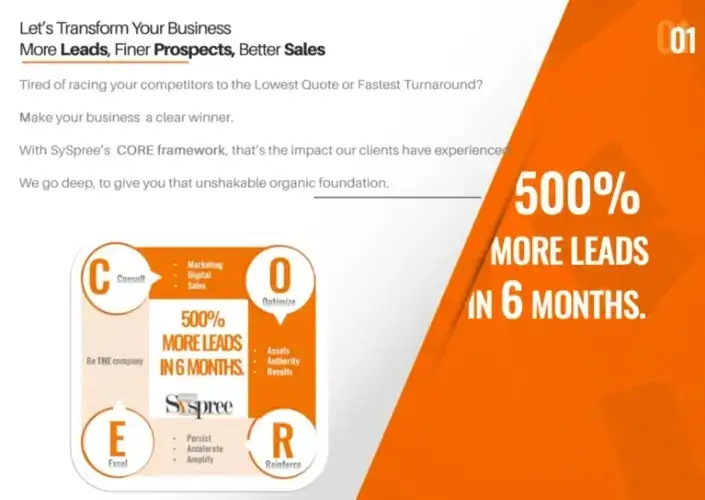
🚀 Want Results Like 500% More Leads in 4 Months?
Let’s talk about what these strategies can do for your business.
We’ll tailor a plan for your goals — no fluff, no pressure.
📧 Or just drop us a line at https://syspree.com/contact/
You may also like ( Author’s curated blogs for you) :
- Unveiling Success: How Corporate Firms Scaled with Digital Marketing Revolution
- How to Create a Digital Marketing Plan for Corporate Services: A Comprehensive Guide for Success
- 10 Proven Web Design Tips to Strengthen Corporate Service Brands
- The Future of Web Designing in Corporate Services: Stay Ahead of the Curve
- Custom Web Design vs Templates: Which Works Better for Corporate Firms?




There is definately a lot to find out about this subject. I like all the points you made
I appreciate you sharing this blog post. Thanks Again. Cool.
Awesome! Its genuinely remarkable post, I have got much clear idea regarding from this post
Very well presented. Every quote was awesome and thanks for sharing the content. Keep sharing and keep motivating others.
Awesome! Its genuinely remarkable post, I have got much clear idea regarding from this post
very informative articles or reviews at this time.
very informative articles or reviews at this time.
Well written article. this topic is becoming more important in 2026. Please continue posting content like this.
This is really interesting, You’re a very skilled blogger. I’ve joined your feed and look forward to seeking more of your magnificent post. Also, I’ve shared your site in my social networks!
I appreciate you sharing this blog post. Thanks Again. Cool.
Nice post. I learn something totally new and challenging on websites
Very well presented. Every quote was awesome and thanks for sharing the content. Keep sharing and keep motivating others.
I like the efforts you have put in this, regards for all the great content.
Awesome! Its genuinely remarkable post, I have got much clear idea regarding from this post
I appreciate you sharing this blog post. Thanks Again. Cool.
Very well presented. Every quote was awesome and thanks for sharing the content. Keep sharing and keep motivating others.
I am truly thankful to the owner of this web site who has shared this fantastic piece of writing at at this place.
Nice post. I learn something totally new and challenging on websites
Pretty! This has been a really wonderful post. Many thanks for providing these details.
I truly appreciate your technique of writing a blog. I added it to my bookmark site list and will
I appreciate you sharing this blog post. Thanks Again. Cool.
I truly appreciate your technique of writing a blog. I added it to my bookmark site list and will