15 Min to Discover Proven IT Growth Strategies Behind Corporate IT Success
Introduction
In a digital economy where technology influences almost every business function, successful companies are doing more than simply adopting new systems. They are transforming how they operate, make decisions, communicate with customers, and scale. Corporate IT Success increasingly depends on connecting technology investments directly with measurable business objectives.
Table of Contents
- Introduction
- IT as a Business Growth Engine
- Case Study 1: EcoTrack’s Digital Transformation
- Addressing Common Business Pain Points With IT
- Pain Point 1: Data Overload
- Pain Point 2: Disconnected Business Systems
- Pain Point 3: Repetitive Manual Work
- Pain Point 4: Technology Performance Problems
- Case Study 2: RetailX Builds a Connected Customer Experience
- The Importance of Customization in IT Strategy
- Building a Scalable Technology Foundation
- Automation as a Productivity Multiplier
- Using Data to Make Better Business Decisions
- Integration: Breaking Down Digital Silos
- Monitor Technology Before Problems Escalate
- A Practical IT Transformation Framework
- How SySpree Supports Corporate IT Transformation
- Lessons From Successful IT Transformations
- Conclusion: Transform Technology Into a Competitive Advantage
For small and medium-sized enterprises, this transformation can create significant opportunities. Organizations that build the right technology foundation can streamline workflows, use data more effectively, strengthen customer experiences, and prepare for expansion. Understanding the principles behind Corporate IT Success can help business leaders determine where technology can create the greatest impact.

IT as a Business Growth Engine
Technology was once viewed primarily as a support function responsible for maintaining computers and solving technical problems. That role has changed dramatically.
Modern Corporate IT Success involves using technology strategically to improve operations, connect departments, analyze information, and develop more scalable ways of working.
What a Strong IT Strategy Can Achieve
- Reduce repetitive manual processes
- Improve access to business information
- Connect previously isolated departments
- Support faster decision-making
- Improve customer experiences
- Prepare systems for future growth
Companies that achieve Corporate IT Success typically begin by identifying business problems first and selecting technology second.
Case Study 1: EcoTrack’s Digital Transformation
From Operational Bottlenecks to a Connected Business
Consider EcoTrack, a hypothetical midsized environmental consulting company experiencing rapid growth. As the company expanded, its existing systems struggled to manage increasing volumes of project information, customer communication, and internal documentation.
Employees spent unnecessary time locating files, transferring information between systems, and manually updating project records. These inefficiencies were beginning to affect service delivery.
EcoTrack’s path toward Corporate IT Success began with a complete assessment of its existing technology environment and operational bottlenecks.
The Technology Strategy
The company modernized its digital infrastructure, introduced centralized cloud-based resources, and connected its customer and project information more effectively.
Third-Party Integrations helped connect important applications so information could move more efficiently between business functions.
Instead of treating individual applications as separate technology purchases, EcoTrack created a connected environment designed around its operational requirements. This became the foundation for long-term Corporate IT Success.

Potential Business Impact
With employees spending less time on manual administration, project teams could concentrate more heavily on customer delivery and strategic work. Managers also gained faster access to operational information.
This scenario demonstrates an important lesson: Corporate IT Success is not determined by how many systems a company owns. It depends on how effectively those systems support employees and business processes.
Key Takeaways for SMEs
- Assess technology gaps before investing in new systems.
- Identify workflows creating unnecessary manual work.
- Select scalable technologies that support future expansion.
- Connect important business applications.
- Measure technology investments against business outcomes.
Addressing Common Business Pain Points With IT
Many organizations recognize their operational problems but struggle to determine which technology improvements should be prioritized.
A practical Corporate IT Success strategy begins by connecting specific business pain points with appropriate technology responses.
Pain Point 1: Data Overload
Turning Information Into Business Intelligence
Businesses generate information through sales, customer interactions, websites, marketing activities, finance systems, and operational processes. Without an organized approach, valuable information can become difficult to analyze.
Data Science and Analytics can help organizations identify patterns, evaluate performance, and convert large datasets into insights that support decision-making.
For many organizations, Corporate IT Success means progressing from simply collecting information to using it strategically.
Potential Data Applications
- Sales performance analysis
- Customer behaviour insights
- Demand forecasting
- Operational performance analysis
- Resource planning
- Management reporting
Pain Point 2: Disconnected Business Systems
Organizations frequently adopt applications at different stages of growth. One department may use a customer management platform while another relies on separate project, finance, or support systems.
When these applications cannot communicate, employees may repeatedly enter the same information or manually transfer data between departments.
Third-Party Integrations can eliminate some of these barriers by allowing applications to exchange information automatically. This connectivity can play a significant role in Corporate IT Success.
Benefits of Connected Systems
- Reduced duplicate data entry
- Faster access to customer information
- More consistent records
- Better collaboration between departments
- Improved reporting

Pain Point 3: Repetitive Manual Work
Administrative processes can consume significant employee time as a business expands. Document classification, report preparation, notifications, request routing, and repetitive data processing are common examples.
AI-Powered Automation can streamline suitable repetitive processes while employees retain responsibility for activities requiring experience and judgment.
Automation contributes to Corporate IT Success when it removes low-value repetitive work without compromising quality or appropriate human oversight.
Pain Point 4: Technology Performance Problems
Slow applications, unexpected downtime, capacity constraints, and recurring technical issues can reduce employee productivity and negatively affect customer experiences.
Performance Monitoring helps technology teams observe system health and identify emerging issues before they develop into major disruptions.
Proactive management is an important part of Corporate IT Success because reliable technology allows employees and customers to interact with business systems consistently.
Case Study 2: RetailX Builds a Connected Customer Experience
Responding to Changing Customer Behaviour
Consider RetailX, a hypothetical midsized retailer facing declining physical-store traffic and increasing competition from online businesses.
Rather than treating its website and physical locations as completely separate channels, RetailX developed a technology strategy that connected customer information, inventory visibility, and digital interactions.
This approach demonstrates how Corporate IT Success can extend beyond internal efficiency and directly influence customer experience.
The Transformation Strategy
RetailX modernized its online systems, improved access to inventory information, and introduced intelligent automation into selected operational processes.
The company also used Data Science and Analytics to understand customer behaviour and identify patterns across digital and physical interactions.
Creating a More Unified Experience
Customers increasingly expect consistent experiences regardless of how they interact with a company. Technology can help organizations connect these touchpoints and provide employees with better customer context.
For RetailX, the foundation of Corporate IT Success was not a single application. It was the coordination of systems, information, employees, and customer experiences.
The Importance of Customization in IT Strategy
No two businesses have identical workflows, customers, employees, technology environments, or growth objectives. A technology strategy that works well for one organization may be unsuitable for another.
Effective Corporate IT Success therefore requires solutions designed around actual business requirements rather than generic technology trends.
Questions to Ask Before Implementing New Technology
- What business problem are we trying to solve?
- Which employees will use the system?
- How will the technology connect with existing applications?
- Can the solution scale as the business grows?
- How will success be measured?
- What support will be required after implementation?
Building a Scalable Technology Foundation
Companies should consider not only their current technology requirements but also where the organization expects to be in several years.
Scalable infrastructure allows additional employees, customers, applications, and data to be supported without repeatedly rebuilding the entire technology environment.
For growing SMEs, Corporate IT Success is closely connected to making technology decisions that support both immediate requirements and future expansion.

Automation as a Productivity Multiplier
Automation can help organizations handle growing workloads without increasing administrative effort at the same rate.
AI-Powered Automation can support activities such as request classification, document processing, notifications, reporting, and routine workflow management.
However, sustainable Corporate IT Success requires businesses to automate selectively. Complex decisions, unusual situations, and high-impact customer interactions should continue to receive appropriate human attention.
Using Data to Make Better Business Decisions
Technology can provide leaders with faster access to information about customers, operations, financial performance, and employee productivity.
Data Science and Analytics can organize and analyze this information to reveal trends that may not be immediately visible through traditional reporting.
Data-driven Corporate IT Success occurs when insights are connected with practical decisions rather than being limited to dashboards that employees rarely use.
Integration: Breaking Down Digital Silos
Disconnected applications can create unnecessary friction as organizations expand. Employees may struggle to locate current information, and customers may be asked to provide the same details repeatedly.
Third-Party Integrations can create smoother information flows between applications and departments.
This interconnected approach supports Corporate IT Success by creating a more consistent technology environment for both employees and customers.
Monitor Technology Before Problems Escalate
IT environments require ongoing oversight. Infrastructure capacity, application response times, system availability, and other technical indicators can change as business demand increases.
Performance Monitoring allows technology teams to identify emerging issues and take corrective action before they cause significant disruption.
Organizations pursuing Corporate IT Success should therefore treat monitoring and optimization as continuous activities rather than waiting for systems to fail.
A Practical IT Transformation Framework
- Assess: Review current systems, workflows, and technology limitations.
- Prioritize: Identify problems creating the greatest business impact.
- Plan: Develop a technology roadmap aligned with business objectives.
- Integrate: Connect important applications and information sources.
- Automate: Streamline suitable repetitive processes.
- Analyze: Turn operational information into useful insights.
- Monitor: Measure technology performance continuously.
- Optimize: Improve systems as business requirements evolve.
Following a structured roadmap makes Corporate IT Success easier to manage because transformation can occur incrementally rather than through a disruptive organization-wide overhaul.
How SySpree Supports Corporate IT Transformation
SySpree helps organizations evaluate their technology environments, identify operational bottlenecks, and develop solutions aligned with measurable business objectives.
Our approach to Corporate IT Success focuses on understanding the company’s workflows, existing applications, data requirements, growth objectives, and customer expectations before recommending technology changes.
SySpree’s IT Transformation Approach
- Technology environment assessment
- Business process evaluation
- Automation opportunity identification
- Application integration planning
- Data strategy development
- Infrastructure optimization
- Continuous technology evaluation
Lessons From Successful IT Transformations
The most important lesson from successful technology transformations is that technology alone rarely solves business problems. Organizations need clear objectives, suitable processes, employee adoption, and ongoing measurement.
Businesses achieve stronger Corporate IT Success when technology initiatives are connected with specific outcomes such as reducing processing time, improving customer experiences, increasing productivity, or enabling growth.
Five Principles to Remember
- Start with the business problem, not the technology.
- Design systems for future scalability.
- Connect applications instead of creating new silos.
- Use automation to support employees.
- Measure results and continuously improve.
Conclusion: Transform Technology Into a Competitive Advantage
Modern corporate firms do not achieve sustainable growth simply by purchasing new software or moving systems online. They succeed when technology becomes strategically connected to business operations and customer requirements.
From eliminating repetitive work and connecting applications to extracting useful insights from data, Corporate IT Success comes from using technology deliberately to solve meaningful business challenges.
For SMEs, transformation does not need to happen all at once. Organizations can begin with their highest-impact technology gaps, measure improvements, and expand successful initiatives over time.
With the right strategy, Corporate IT Success can help businesses become more efficient, connected, adaptable, and prepared for future growth.
Ready to transform your business through technology? Contact SySpree today to explore an IT strategy designed around your operational challenges, digital goals, and long-term growth ambitions.
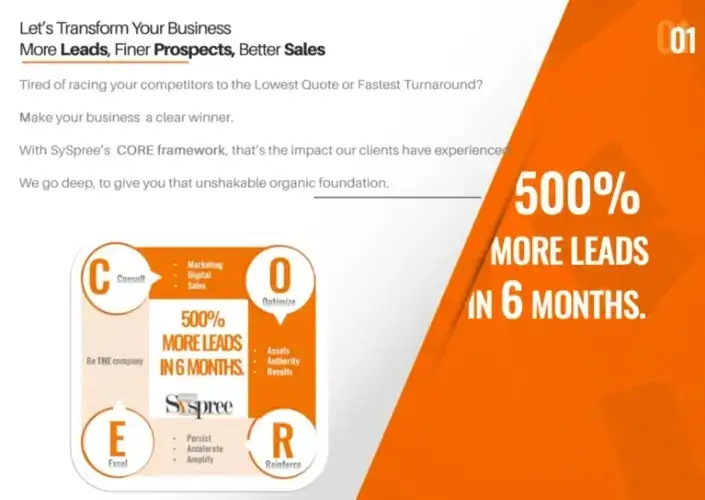
🚀 Want Results Like 500% More Leads in 4 Months?
Let’s talk about what these strategies can do for your business.
We’ll tailor a plan for your goals — no fluff, no pressure.
📧 Or just drop us a line at https://syspree.com/contact/
- Building a Robust IT Infrastructure for Corporate Services: A Roadmap to Enterprise Success
- 8 AI Solutions Revolutionizing the Corporate Services Industry
- The Future of Artificial Intelligence in Corporate Services: Unlocking New Horizons
- AI Tools vs. Human Expertise: Which Works Better in Corporate Firms?
- Fresh Observations on AI Adoption in Corporate Services: Navigating the Future of Business Success