15 Min to Compare Business Value and Expertise with AI Tool vs Human
Introduction
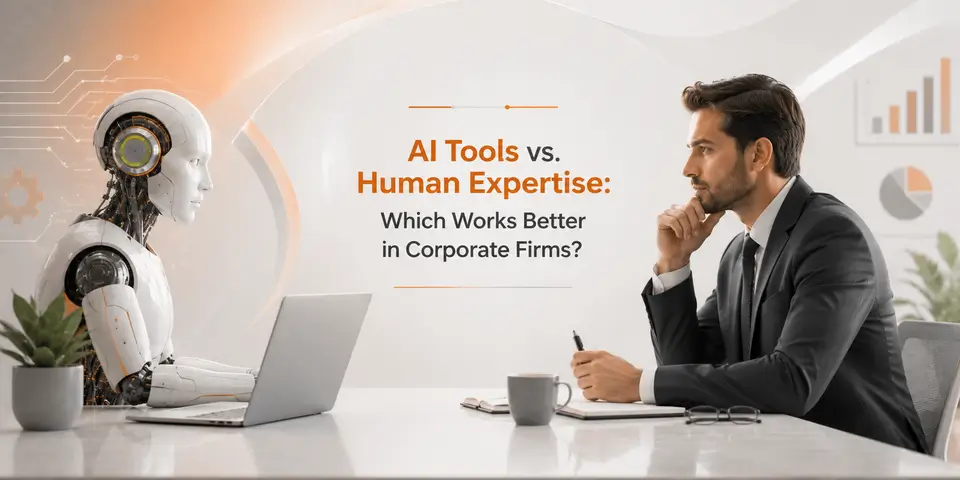
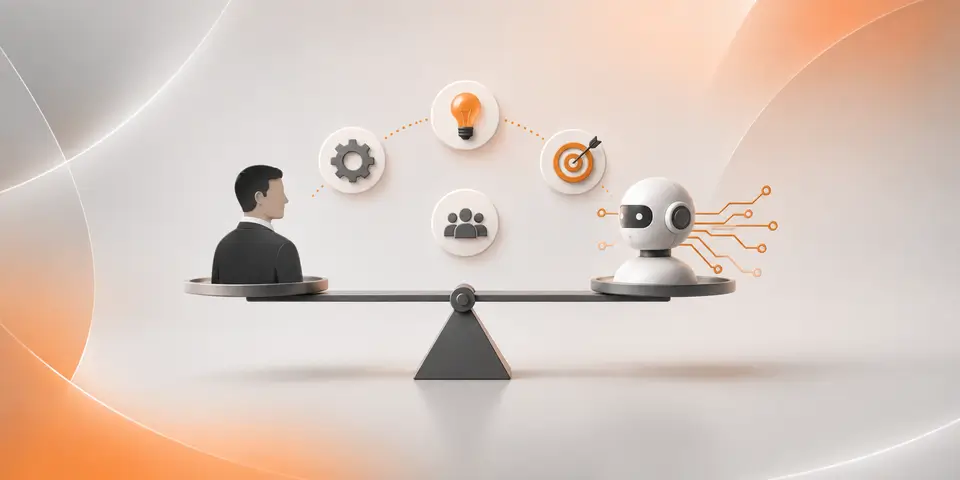
Corporate decision-makers increasingly face an important question: how much work should be handled by intelligent technology, and where should experienced professionals remain in control? The AI Tool vs Human discussion is therefore not simply about replacing people with software. It is about determining how technology and human expertise can work together to improve productivity, decision-making, and customer experiences.
Table of Contents
- Introduction
- The AI Revolution in Corporate Services
- 1. Cost Efficiency: Where AI Has an Advantage
- 2. Scalability: Handling Growing Workloads
- 3. Data Processing and Predictive Insights
- The Limitations of Relying Solely on AI
- The Irreplaceable Value of Human Expertise
- The Limitations of Relying Solely on Humans
- Finding the Right Balance
- Customer Service: A Practical Example
- Marketing and Customer Insights
- Decision-Making: Data Meets Judgment
- How SySpree Combines AI and Human Expertise
- Overcoming AI Implementation Barriers
- A Practical Framework for Corporate Firms
- Conclusion: AI and Humans Work Better Together
For medium-sized enterprises seeking sustainable growth, understanding the strengths and limitations within the AI Tool vs Human debate can help leaders build a more efficient operating model without sacrificing creativity, judgment, or meaningful relationships.
The AI Revolution in Corporate Services
What Are AI Tools?
Artificial Intelligence tools are systems designed to perform tasks that traditionally required human analysis or intervention. They can process large datasets, identify patterns, automate repetitive workflows, generate content, forecast outcomes, and assist with customer interactions.
From AI-Powered Automation to intelligent analytics, the AI Tool vs Human comparison becomes increasingly relevant as these systems take on larger roles within everyday corporate operations.
Where AI Creates the Most Value
- Automating repetitive administrative tasks
- Analyzing large volumes of information
- Identifying patterns and anomalies
- Supporting forecasting and planning
- Providing basic customer assistance
- Generating reports and summaries
When used appropriately, AI Tool vs Human strategies can reduce the amount of time employees spend on routine activities and allow them to concentrate on work requiring deeper expertise.
1. Cost Efficiency: Where AI Has an Advantage
Routine processes can become expensive when every transaction requires manual intervention. Data entry, document classification, report preparation, scheduling, and basic customer enquiries are examples of activities that can often be streamlined.
In the AI Tool vs Human comparison, AI can offer significant efficiency advantages when tasks are repetitive, rules-based, and performed at high volume.
How Automation Supports Efficiency
AI-Powered Automation can execute predefined workflows consistently and at scale. Businesses can use it for document processing, task routing, internal notifications, and other repetitive processes.
However, an effective AI Tool vs Human model should still include human oversight when errors could have financial, legal, ethical, or customer consequences.
2. Scalability: Handling Growing Workloads
As companies grow, they receive more customer enquiries, generate more data, process more transactions, and manage more internal workflows. Scaling every activity through additional employees can increase costs quickly.
AI systems can handle larger volumes of repetitive work without requiring an equivalent increase in headcount. This makes scalability one of the strongest arguments within the AI Tool vs Human discussion.

Where Humans Remain Essential
Scale alone does not guarantee quality. Complex negotiations, relationship management, strategic decisions, and unusual situations still benefit from human understanding and accountability.
3. Data Processing and Predictive Insights
Modern businesses collect information from websites, CRM platforms, transactions, customer interactions, marketing campaigns, and operational systems. Analyzing these datasets manually can be slow and difficult.
Predictive Analytics can identify trends and estimate future outcomes using historical information. In an AI Tool vs Human framework, AI can perform the large-scale analysis while professionals interpret the results within the broader business context.
Potential Applications
- Sales forecasting
- Customer churn analysis
- Demand forecasting
- Lead prioritization
- Resource planning
- Operational risk identification
The Limitations of Relying Solely on AI
AI systems are powerful, but their outputs depend on their design, data, instructions, and operating environment. They can produce inaccurate information, reflect problems in underlying data, or fail to understand context that would be obvious to an experienced professional.
This is why the AI Tool vs Human decision should rarely involve giving automated systems complete control over high-impact business decisions.
AI Can Lack Context
An AI system may identify patterns without understanding the relationships, cultural considerations, or strategic circumstances surrounding them.

AI Requires Oversight
Outputs should be reviewed according to the importance and risk of the task. Human oversight is particularly important in financial, legal, HR, security, and sensitive customer situations.
AI Depends on Quality Inputs
Poor data and unclear instructions can produce poor results. Prompt Engineering can help teams structure interactions with generative AI more effectively, but employees still need to evaluate the resulting information critically.
The Irreplaceable Value of Human Expertise
Human professionals bring capabilities that technology cannot reliably reproduce across every business situation. Experience, empathy, ethical judgment, creativity, intuition, and contextual understanding remain central to many corporate roles.
Within the AI Tool vs Human discussion, these qualities explain why successful AI adoption should enhance human capability rather than simply attempt to eliminate human involvement.
1. Emotional Intelligence
Customer complaints, employee concerns, negotiations, and leadership conversations often require an understanding of emotion, tone, and relationships.
An effective AI Tool vs Human strategy can use AI to provide useful information while allowing people to manage conversations requiring empathy and discretion.
2. Adaptability
Experienced professionals can respond to unexpected circumstances even when no predefined process exists. They can combine incomplete information with previous experience and situational awareness.
3. Creative Problem-Solving
AI can generate possibilities and analyze alternatives, but humans remain responsible for deciding which ideas make sense within a company’s goals, customers, resources, and culture.
This complementary relationship strengthens the AI Tool vs Human model by combining computational speed with human judgment.
The Limitations of Relying Solely on Humans
Human expertise also has limitations. Employees have finite time, can make mistakes, and may struggle to analyze extremely large datasets quickly.
Manual processes can also become expensive as companies scale. The AI Tool vs Human question therefore needs to account for the limitations on both sides rather than assuming one approach is universally superior.
Finding the Right Balance
The strongest corporate strategy usually assigns work according to comparative strengths. AI handles repetitive processing and large-scale analysis, while people remain responsible for judgment, strategy, relationships, and accountability.
This balanced AI Tool vs Human structure can help companies improve productivity without losing the human qualities that customers and employees value.
Tasks AI Can Support
- Data processing
- Routine reporting
- Document classification
- Basic customer enquiries
- Forecasting
- Workflow automation

Tasks That Benefit Strongly From Human Expertise
- Strategic leadership
- Complex negotiations
- Sensitive customer interactions
- Ethical decision-making
- Creative direction
- Employee leadership
Customer Service: A Practical Example
Customer support demonstrates the value of combining technology and people particularly well. Chatbots and Virtual Assistants can answer frequently asked questions, collect information, and route enquiries automatically.
In this AI Tool vs Human scenario, routine questions can be handled quickly by AI while difficult complaints or high-value conversations are escalated to experienced employees.
The result can be faster service without forcing customers to depend entirely on automation.
Marketing and Customer Insights
AI can analyze customer activity, campaign performance, and purchasing behaviour at a scale that would be difficult for individual employees.
Within an AI Tool vs Human marketing strategy, technology can identify useful patterns while marketers determine the positioning, creative direction, and communication strategy.
Behavior-Based Personalization
Behavioral Targeting can help businesses personalize messages based on previous interactions and engagement. Human teams can then ensure those messages remain relevant to the brand and appropriate for the audience.
Decision-Making: Data Meets Judgment
AI can provide forecasts, recommendations, and summaries, but business leaders remain responsible for understanding the consequences of major decisions.
A mature AI Tool vs Human framework therefore treats AI as decision support rather than an unquestioned decision-maker.
How SySpree Combines AI and Human Expertise
At SySpree, the goal is to help businesses identify where intelligent technology can create measurable value while preserving human oversight in areas where expertise matters most.
Our AI Tool vs Human approach begins by examining workflows, customer experiences, existing systems, available data, and business objectives.
SySpree’s Integrated Capabilities
- AI-Powered Automation
- Predictive Analytics
- Prompt Engineering
- Data Science and Analytics
- Chatbots and Virtual Assistants
- Third-Party Integrations
These capabilities can help companies build an AI Tool vs Human operating model that uses automation where it improves efficiency and human expertise where context, creativity, and accountability are essential.
Overcoming AI Implementation Barriers
Identify the Right Processes
Start with processes that are repetitive, measurable, and time-consuming. Avoid automating complex decisions simply because the technology is available.
Define Human Oversight
Businesses should clearly determine which automated outputs require employee review and who remains accountable for final decisions.
Train Employees
Employees need practical training to understand how AI tools work, how to assess outputs, and when to intervene.
Training makes the AI Tool vs Human relationship more productive because employees learn to treat AI as a capability they can use rather than a system they must compete against.
Integrate Technology Carefully
Third-Party Integrations can connect AI tools with CRM systems, analytics platforms, help desks, and other existing applications, reducing unnecessary disruption.
Monitor Results
Performance should be measured using metrics such as processing time, accuracy, customer satisfaction, employee productivity, and cost efficiency.
A Practical Framework for Corporate Firms
- Identify repetitive and data-intensive workflows.
- Determine where human judgment is essential.
- Select a focused AI use case.
- Define measurable success criteria.
- Assign human review and accountability.
- Train employees to use the technology effectively.
- Measure performance and collect feedback.
- Expand successful use cases gradually.
Following this framework helps companies make the AI Tool vs Human decision according to business value rather than assumptions about either technology or people.
Conclusion: AI and Humans Work Better Together
The debate should not focus on whether AI tools or human professionals should dominate the modern workplace. Each offers different strengths and limitations.
The most effective AI Tool vs Human strategy combines AI’s speed, scalability, and analytical capacity with human creativity, empathy, experience, and judgment.
For growing corporate firms, this combination can create faster operations, stronger decisions, and better customer experiences while maintaining appropriate human accountability.
Companies that develop a thoughtful AI Tool vs Human framework can use technology to amplify their teams rather than simply attempting to replace them.
Ready to combine AI efficiency with human expertise? Contact SySpree to develop an intelligent business strategy aligned with your operations and growth objectives.
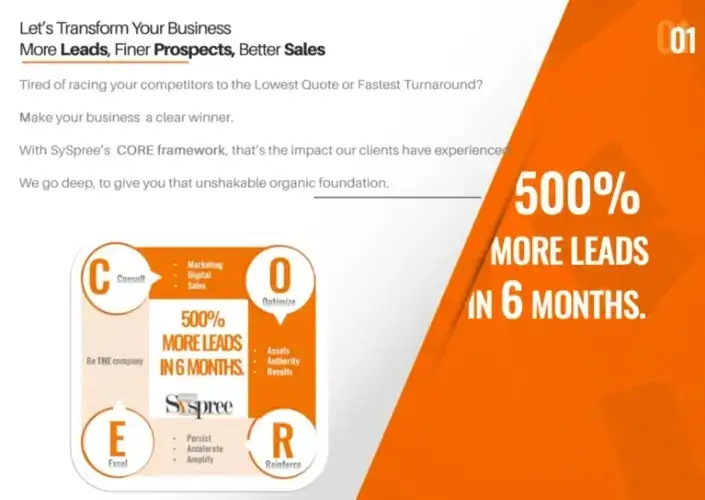
🚀 Want Results Like 500% More Leads in 4 Months?
Let’s talk about what these strategies can do for your business.
We’ll tailor a plan for your goals — no fluff, no pressure.
📧 Or just drop us a line at https://syspree.com/contact/
You may also like ( Author’s curated blogs for you) :
- Fresh Observations on AI Adoption in Corporate Services: Navigating the Future of Business Success
- Why Ignoring AI Slows Down Corporate Firms: The Untapped Potential of AI for Business Growth
- Analyzing AI’s Role in Automating Corporate Services: The Future is Here
- Transforming Success: Inspiring AI Innovation Stories from Top Corporate Firms
- How to Apply AI to Transform Corporate Service Delivery: A Game-Changer for Business Growth