
15 Min to Build Scalable Business Growth with Corporate Digital Plan
Introduction
In a digital environment that changes rapidly, corporate service firms need more than an active website or occasional marketing campaign. They need a structured Corporate Digital Plan that connects business goals with the right audiences, channels, content, and performance measures.
Table of Contents
- Introduction
- Why Corporate Services Need a Tailored Digital Strategy
- 1. Define Clear and Measurable Goals
- 2. Segment the Target Audience
- 3. Conduct a Competitor and Market Analysis
- 4. Clarify the Value Proposition
- 5. Build a Content Marketing Strategy
- 6. Strengthen Search Engine Optimization
- 7. Use Pay-Per-Click Advertising Strategically
- 8. Develop a Focused Social Media Strategy
- 9. Use Email Marketing to Nurture Relationships
- 10. Optimize the Website for Conversions
- 11. Connect Marketing Systems and Data
- 12. Measure and Improve Performance
- How SySpree Supports Corporate Digital Growth
- Conclusion
Without clear direction, companies can spend heavily on marketing while generating limited returns. A well-built Corporate Digital Plan helps decision-makers prioritize resources, improve targeting, strengthen brand visibility, and create a more predictable pipeline of qualified opportunities.

Why Corporate Services Need a Tailored Digital Strategy
Corporate service providers often sell complex, high-value solutions with longer decision cycles. Their buyers may include senior executives, department heads, procurement teams, and business owners. A generic marketing approach rarely addresses the concerns of these different audiences.
A tailored Corporate Digital Plan creates a clear path from awareness to consideration and conversion. It ensures that every campaign, page, email, and advertisement supports a defined business objective.
Common Challenges for High-Revenue Firms
- Maintaining a competitive edge: Digital channels change quickly, and competitors continue to improve their messaging and targeting.
- Reaching decision-makers: Corporate audiences are smaller, more selective, and often harder to engage.
- Optimizing resources: Marketing budgets must be allocated to the channels that produce the strongest commercial impact.
- Measuring long sales cycles: Leads may interact with multiple touchpoints before contacting the business.
A focused Corporate Digital Plan helps businesses overcome these challenges through measurable priorities and coordinated execution.
1. Define Clear and Measurable Goals
Every strategy should begin with specific business outcomes. Broad goals such as increasing awareness are difficult to measure and even harder to manage.
Your Corporate Digital Plan should use SMART goals that are specific, measurable, achievable, relevant, and time-bound.
- Increase qualified website enquiries by 25% in six months.
- Generate 40 sales-ready B2B leads each quarter.
- Reduce the average cost per lead by 15%.
- Increase organic traffic to service pages by 30%.
- Improve email-to-consultation conversion rates.
Clear goals provide direction and make it easier to evaluate success.
2. Segment the Target Audience
Corporate buyers are not a single audience. Their priorities vary according to industry, company size, role, budget, geography, and stage in the buying journey.
Audience segmentation allows the Corporate Digital Plan to deliver more relevant messages to each group.
Build Detailed Buyer Profiles
Effective profiles should include job responsibilities, operational challenges, decision criteria, preferred content formats, common objections, and the channels used for research.
For example, a human resources consultancy may create separate campaigns for technology companies, manufacturers, and professional services firms. Each segment receives content that reflects its own workforce challenges.
Use Behavioral Targeting
Behavioral Targeting allows companies to adapt campaigns based on website activity, content engagement, previous interactions, and demonstrated intent. This makes the Corporate Digital Plan more responsive to real user behaviour.

3. Conduct a Competitor and Market Analysis
Competitor analysis helps businesses understand how others position their services, attract traffic, publish content, and engage potential clients.
A strong Corporate Digital Plan should evaluate competitor strengths, weaknesses, keyword visibility, advertising activity, content quality, social presence, and conversion journeys.
Questions to Explore
- Which services do competitors emphasize most strongly?
- What topics attract engagement and backlinks?
- Which keywords appear across their service pages?
- How clearly do they communicate their value proposition?
- Where do gaps exist in their customer experience?
This research helps the Corporate Digital Plan focus on opportunities rather than copying what already exists.
4. Clarify the Value Proposition
A corporate website and its campaigns should explain why a prospective client should choose your company over another provider. The value proposition must be specific, credible, and relevant to the target audience.
Your Corporate Digital Plan should translate services into business outcomes such as reduced risk, higher efficiency, stronger compliance, faster delivery, or improved profitability.
Support these claims with case studies, client testimonials, industry expertise, measurable results, and clear service processes.

5. Build a Content Marketing Strategy
Content Marketing helps corporate firms demonstrate expertise and guide buyers through complex decisions. High-value audiences often require education and reassurance before they are ready to speak with a sales team.
The Corporate Digital Plan should include a content calendar aligned with audience questions, sales priorities, and search demand.
Useful Corporate Content Formats
- Industry reports and research summaries
- Detailed service guides
- Case studies with measurable outcomes
- Executive checklists
- Webinars and expert interviews
- Comparison articles and decision guides
- Email newsletters and insight series
Consistent publishing strengthens the Corporate Digital Plan by supporting visibility, trust, and lead nurturing.
6. Strengthen Search Engine Optimization
Search Engine Optimization (SEO) helps potential clients discover your business when they actively search for solutions. Corporate SEO requires strong service pages, technical performance, authoritative content, internal links, and credible backlinks.
An effective Corporate Digital Plan should address both technical and content-driven SEO.
Key SEO Priorities
- Map primary keywords to relevant service pages.
- Create content around high-intent business questions.
- Improve page titles, headings, and meta descriptions.
- Strengthen internal linking between related services.
- Optimize speed, mobile usability, and crawlability.
- Earn reputable links through useful resources and partnerships.
SEO provides the Corporate Digital Plan with a long-term channel for attracting qualified demand.
7. Use Pay-Per-Click Advertising Strategically
Pay-Per-Click Advertising (PPC) can generate immediate visibility for high-intent searches and important service categories. It is particularly valuable when organic rankings are still developing.
The Corporate Digital Plan should use PPC selectively, focusing on strong commercial keywords, specific audience groups, and conversion-focused landing pages.
Improve PPC Efficiency
- Separate campaigns by service and audience intent.
- Use negative keywords to reduce irrelevant clicks.
- Create dedicated landing pages for major campaigns.
- Track calls, forms, consultations, and qualified opportunities.
- Review cost per lead and lead quality together.

8. Develop a Focused Social Media Strategy
For many corporate service firms, LinkedIn is a key platform for building authority and reaching decision-makers. Social Media Marketing should educate, inform, and encourage discussion rather than simply promote services.
A balanced Corporate Digital Plan may include executive insights, client outcomes, industry commentary, company updates, employee expertise, and practical advice.
Create a Consistent Publishing Rhythm
Consistency builds familiarity. A realistic schedule is more effective than irregular bursts of activity. Companies should also encourage leaders and subject-matter experts to participate in the conversation.
9. Use Email Marketing to Nurture Relationships
Email Marketing remains valuable for nurturing prospects who are interested but not yet ready to purchase. Segmented email campaigns can deliver relevant resources, event invitations, case studies, and service updates.
The Corporate Digital Plan should avoid sending the same message to every subscriber. Emails should reflect audience interests, buying stage, and previous engagement.
Email Campaign Ideas
- Welcome and educational sequences
- Industry-specific newsletters
- Event and webinar invitations
- Case study follow-ups
- Consultation reminders
- Re-engagement campaigns
10. Optimize the Website for Conversions
Traffic has limited value if visitors cannot understand the offer or take the next step. A conversion-focused website should make services, evidence, and contact options easy to find.
UI/UX Audits can reveal confusing navigation, weak calls to action, poor mobile experiences, and unnecessary friction. These insights help refine the Corporate Digital Plan and improve conversion performance.
Conversion Improvements to Consider
- Simplify enquiry forms.
- Add clear calls to action across service pages.
- Use testimonials and case studies near conversion points.
- Create landing pages for specific audiences.
- Improve mobile usability and page speed.
- Test alternative headlines, offers, and layouts.
11. Connect Marketing Systems and Data
Corporate marketing often involves websites, CRM platforms, analytics tools, email systems, advertising accounts, and sales software. Disconnected systems make it difficult to understand the complete customer journey.
Third-Party Integrations can connect these platforms and give the Corporate Digital Plan more accurate data for attribution, lead management, and follow-up.
12. Measure and Improve Performance
A strategy should evolve according to evidence. Marketing teams need to monitor traffic, lead quality, conversion rates, engagement, acquisition costs, and sales outcomes.
Custom Reporting can organize these metrics into clear dashboards that support faster decisions. This makes the Corporate Digital Plan easier to manage across leadership, marketing, and sales teams.
Important Metrics to Track
- Organic and paid website traffic
- Qualified leads by source
- Cost per lead and cost per acquisition
- Landing page conversion rates
- Email open and click-through rates
- Content engagement and assisted conversions
- Pipeline value influenced by marketing
Regular reporting keeps the strategy aligned with changing business priorities and audience behaviour.
How SySpree Supports Corporate Digital Growth
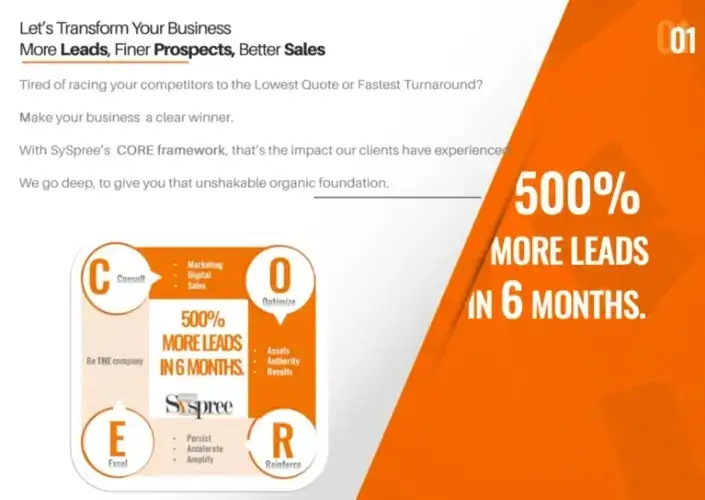
SySpree combines strategy, SEO, paid advertising, content, social media, email, analytics, and conversion optimization to create connected marketing systems for corporate service providers.
Rather than managing channels in isolation, we build campaigns around clear commercial objectives. This integrated approach helps businesses improve visibility, attract stronger leads, and convert more opportunities.
Conclusion
Building a successful digital marketing strategy requires clarity, coordination, and continuous improvement. Corporate service firms must understand their audiences, define measurable goals, choose the right channels, and track outcomes that matter to the business.
A carefully executed Corporate Digital Plan transforms digital marketing from a collection of disconnected activities into a structured engine for sustainable growth.
Ready to build a focused digital strategy for your corporate services? Contact SySpree to create a plan designed around your audience, goals, and growth priorities.
🚀 Want Results Like 500% More Leads in 4 Months?
Let’s talk about what these strategies can do for your business.
We’ll tailor a plan for your goals — no fluff, no pressure.
📧 Or just drop us a line at https://syspree.com/contact/
You may also like ( Author’s curated blogs for you) :
- 10 Proven Web Design Tips to Strengthen Corporate Service Brands
- The Future of Web Designing in Corporate Services: Stay Ahead of the Curve
- Custom Web Design vs Templates: Which Works Better for Corporate Firms?
- Unveiling 2026’s Web Design Trends for Corporate Services: Elevate Your Digital Presence
- The Hidden Cost: Why Outdated Design Damages Trust in Corporate Service Firms




I just like the helpful information you provide in your articles
I just like the helpful information you provide in your articles
very informative articles or reviews at this time.
I like the efforts you have put in this, regards for all the great content.
I just like the helpful information you provide in your articles